
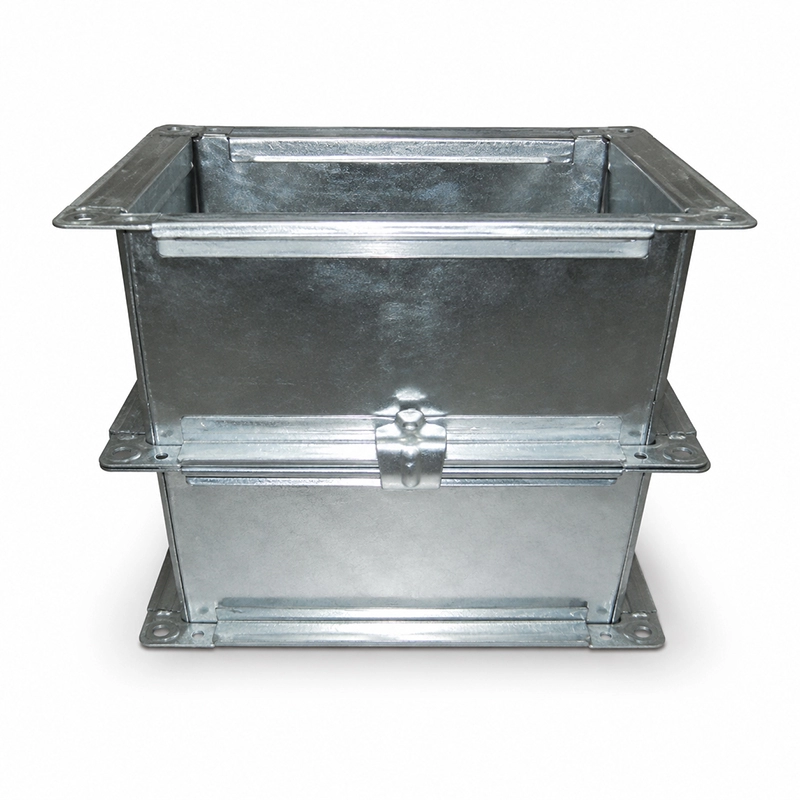
Two dampers, two different jobs
On a schedule of dampers, a fire damper and a smoke control damper can look interchangeable: both sit in a duct, both have blades, both close. In a fire they do opposite things. A fire damper closes to stop fire spreading through the duct. A smoke control damper stays open, to keep extracting smoke from the space people are trying to leave. Confusing the two is one of the more serious specification errors in an HVAC package.
What the temperature rating actually tells you
The 70 °C and 280 °C figures are not a measure of how much heat the damper can survive. They describe the temperature at which the damper is intended to operate, and by implication what the system around it is designed to do.
| Rating | Purpose | Typical operation | Where it belongs |
|---|---|---|---|
| 70 °C | Fire containment | Closes on temperature rise | General supply and extract ductwork crossing fire compartments |
| 280 °C | Smoke extraction | Remains open and operational at high temperature | Smoke extract shafts, corridor and atrium smoke systems, car park extract |
The 70 °C fire damper
A 70 °C damper closes when the air in the duct reaches that temperature — normally via a fusible link, sometimes via a thermal detector linked to a motor. It is the standard protective device where a duct passes through a fire-rated wall or floor and the duct is part of normal ventilation, not a smoke extract path. The duct itself is also required to be fire-rated at that penetration, and the damper is only as good as the sleeve and sealing around it.
The weak points in practice are rarely the damper. They are the access door that was never provided, so the link could not be inspected; the blade blocked by a cable tray installed after handover; or a spring that has sat compressed for years in a damp plant room.
The 280 °C smoke control damper
A 280 °C damper has to do something harder: continue to operate — open, or at least remain functional — while the air passing through it is at 280 °C. That requires the actuator, the bearings and the blade seals to survive temperatures that would destroy a standard damper. Motorised operation is normal here, because the damper has to be commanded open by the fire alarm system rather than closing by itself.
Note that 280 °C is a duration rating, not simply a threshold. A damper certified to 280 °C is certified to hold that performance for a stated period, and the certificate states which. When comparing quotations from different suppliers, comparing that period is more informative than comparing the headline number.
Fusible link or motorised?
A fusible link is simple, needs no power and fails safe: heat melts the link, the spring closes the blade. Its limitation is that it cannot be commanded. A motorised damper can be opened or closed on signal from the fire alarm panel, which is essential for smoke control strategies, and it can be monitored — the panel knows whether the blade actually reached position. Many projects use both: motorised dampers in the smoke control system, fusible link dampers in general ventilation.
Access, inspection and testing
A damper that cannot be reached cannot be maintained, and an unmaintained damper is a liability rather than a safeguard. Three practical requirements:
- An access door adjacent to every damper, large enough to reset the mechanism by hand — not simply to look at it.
- A test point so the link or actuator can be tripped without dismantling ductwork.
- A schedule of dampers kept with the O&M documentation, listing location, type, rating and the last test date.
What to put on the purchase order
- Rating: 70 °C or 280 °C, and the certified duration for the latter.
- Operation: fusible link, motorised, or motorised with spring return.
- Duct size and orientation, with the sleeve and flange arrangement.
- Blade type and leakage class at the closed position.
- Actuator voltage and the control signal it expects.
- Access door, and whether it is to be supplied with the damper.
We fabricate fire dampers and smoke control dampers alongside the ductwork on the same production lines, which means the sleeve, flange and duct end are made to match rather than reconciled on site. On infrastructure projects — subways, airports and convention centres among them — that coordination is usually what keeps the smoke control system passing its commissioning test first time.