
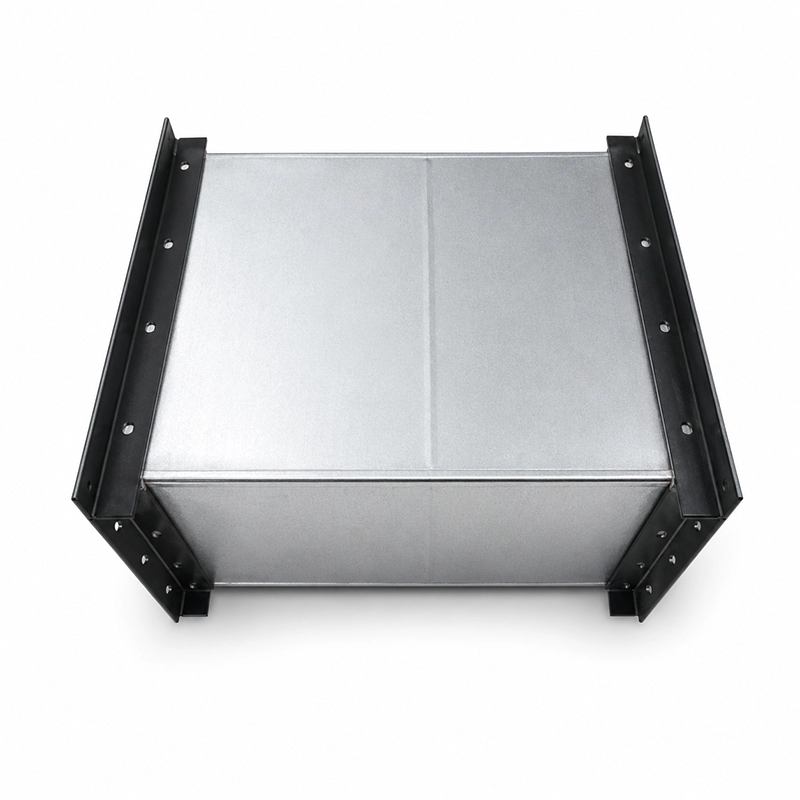
The joint is where a duct system actually fails
Sheet metal is reliable. A flat panel of galvanised steel either holds pressure or it does not, and that is settled at the drawing stage. Joints are different: they are assembled on site, by hand, at height, often at the end of a long day. That is why a duct system can be fabricated perfectly and still miss its leakage target — and why the connection system deserves a decision of its own rather than being inherited from whatever the last project used.
Three systems, one comparison
| Factor | Angle-iron flange | TDF / common flange | Slip joint |
|---|---|---|---|
| How it is formed | L-angle riveted or bolted to duct ends | Flange folded directly from the duct sheet | Duct end inserted into the next section |
| Rigidity | Highest — flange acts as a stiffener | Moderate; dependent on fold quality | Lowest |
| Installation speed | Slowest — more bolts per joint | Fast — clamp or bolt, no separate flange | Fastest |
| Leakage | Low when gasketed and bolted correctly | Low to moderate | Highest; needs sealant |
| Fabrication cost | Higher — extra material and labour | Low — formed in the same operation | Lowest |
| Best used for | Large ducts, high pressure, plant rooms | General distribution ductwork | Low-pressure branches and short runs |
Angle-iron flange: the heavy-duty standard
An angle-iron flange does two jobs at once. It provides the bolting face, and it stiffens the duct end against the pressure that would otherwise bow the panel. On large rectangular ducts — say 1500 mm and above — that second job is the reason to specify it. The flange carries load that the sheet alone cannot.
The cost is in the labour. Each joint takes more bolts, more time and more care to gasket properly. On a project with hundreds of joints, that adds up. Specify angle-iron where the duct is large, the pressure is high, or the run passes through a plant room where future access and rigidity matter.
TDF and common flange: formed in one pass
The TDF (transverse duct flange) system folds the flange out of the duct sheet itself during forming. There is no separate angle to cut, drill and rivet, so fabrication is faster and lighter. Joints close with a dedicated clamp or a bolt-and-corner arrangement, and a properly formed TDF joint with a gasket performs well at the pressures found in normal commercial distribution.
Its limits are structural rather than functional. Because the flange is the same thickness as the duct, it stiffens less than angle iron. On large ducts or high static pressures you will still need reinforcement — either internal tie rods or external framing — to stop the panel from breathing.
Slip joint: simple, and best kept simple
A slip joint overlaps one duct section into the next and is sealed with mastic or tape. It is fast, cheap and entirely adequate on low-pressure extract and branch runs where the duct is small and the pressure is close to atmospheric. Used outside that envelope — on a long run, at higher pressure, or where vibration is present — it becomes a leak path that no amount of sealant will fully close.
The practical rule is to keep slip joints to the last branches. Anything carrying air a long distance should be flanged.
Gaskets, sealant and the details that decide leakage class
The connection type sets the ceiling on leakage; the detailing decides whether you reach it. Three things matter most:
- Continuous gasket. A gasket that stops short at a corner is a leak. Butt joints should be at a bolt, not mid-span.
- Sealant applied to the inside of the joint on the pressure side, not smeared over the outside where it will peel.
- Correct bolt spacing and torque. Overtightening a gasket crushes it; undertightening leaves a gap. Both leak.
Six-point checklist before you order
- What leakage class does the specification actually require?
- What is the maximum static pressure in the system?
- What is the largest duct dimension? This alone may decide the system.
- How many joints are there? Speed of assembly scales with joint count.
- Is any of the run difficult to access later? Favour the more rigid system there.
- Are gaskets and clamps included in the order, or being sourced separately on site?
We form angle-iron, TDF and slip-joint duct ends on the same lines, so a system that mixes all three — heavy flanges in the plant room, TDF through the distribution, slip joints at the terminals — arrives as one coordinated package with matching gaskets.